Best Espresso Machine for Home: How to Choose Without Cafe Hype
The best espresso machine is the one that matches your mornings: how many drinks, how much fuss, and whether you already own a solid grinder.
By Alex Turner
Baristapicks is reader-supported. As an Amazon Associate we earn from qualifying purchases. Learn more.
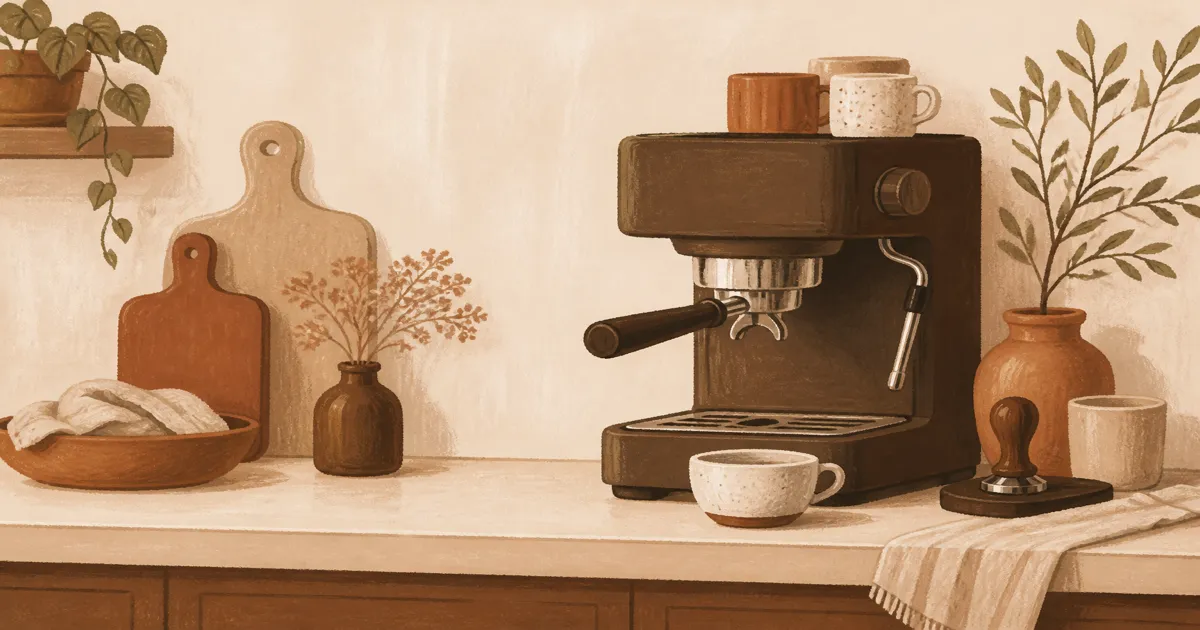
The short answer: The best espresso machine for home is usually a semi-automatic you can keep clean, paired with a real espresso grinder. Buy for drink volume, milk needs, and counter space before you chase cafe branding.
If you are hunting for the best espresso machine, ignore showroom chrome for a minute. Weekday coffee is about heat stability, steam that finishes before you burn the milk, and a workflow you will still do on a Tuesday.
This guide is research-based: we compare published specs, common failure points, and what shows up again and again in buyer feedback. We have not lab-tested every SKU in this article. For a gentler first buy, see our beginner espresso machine guide. Grinder pairing lives in our coffee grinder and espresso burr guides.
What “best” means on a home counter
Cafe machines win on recovery and duty cycle. Home machines win when they fit your routine. Ask three questions before you compare model sheets.
First, how many milk drinks do you make in a row? One latte is easy for almost anything with a steam wand. Three cappuccinos for guests is where single boilers feel slow.
Second, will you grind fresh every shot? If yes, put money into the grinder early. If you want push-button beans-to-cup, a super-automatic may be the honest fit.
Third, how much space and cleaning patience do you have? Group heads, drip trays, and milk systems all need weekly care. A prettier machine you hate to wipe down will sit unused.
Semi-auto, heat exchange, dual boiler, or super-auto
Semi-automatic machines ask you to grind, dose, tamp, and start the pump. You control timing. They teach you espresso fast and usually taste better once dialed in.
Heat-exchange designs keep a brew boiler ready while you steam from a heat exchanger. Good for milk drinks without a second full boiler. You still manage flush and temperature habits.
Dual boiler setups separate brew and steam. Best when you pull and steam at the same time often. You pay in size, price, and warm-up energy.
Super-automatic machines grind, dose, and brew with buttons. Great for speed and guests. You give up a lot of recipe control, and repairs can cost more than a simple semi-auto.
There is no moral ranking. There is only fit. If your mornings are chaotic, convenience can beat a “better” extraction chart.
Specs that change the cup
Look past wattage bragging. Useful signals:
- Boiler or thermoblock type: Thermoblocks heat fast and suit lighter use. Larger boilers hold temperature better for back-to-back drinks.
- Pump pressure marketing: “15 bar” stickers are common. What matters more is stable brew pressure around 9 bar at the puck and a machine that does not surge wildly.
- Portafilter size: 58mm ecosystems have more baskets, screens, and accessories. Smaller pressurized baskets can help beginners with pre-ground coffee.
- Steam power: A wand that textures milk in under a minute keeps drinks hot. Weak steam makes you wait and cool the cup.
- PID temperature control: Helpful if you chase light roasts or want repeatable setpoints. Not required for tasty medium-roast home espresso.
Also check real depth on the counter, drip tray capacity, and whether the water tank is front-access. Small annoyances become dealbreakers after month two.
Budget bands that stay honest
Under about $300: Expect entry thermoblock or small boiler machines. Many include pressurized baskets. Fine for milk drinks with forgiving coffee. Pair with a better grinder as soon as you can.
About $300–$800: The sweet spot for many homes. Look for sturdier build, better steam, and a path to non-pressurized baskets. This is where “best espresso machine” lists usually cluster for good reason. If your hard cap is $1000, see our under-$1000 picks.
About $800–$2,000: Dual boilers, stronger steam, better temperature tools, and longer parts support. Worth it if you brew daily and care about milk texture and repeatability.
Above that: Prosumer territory. Buy only if you already know you want the hobby side of espresso, not just a nicer Americano.
Whatever the band, leave room for a burr grinder that can do espresso. A weak grind caps every machine above it.
Workflow matters more than brand myth
A machine earns a spot when the daily loop is short: fill water, grind, pull, steam, wipe, knock out the puck into an espresso knock box. If any step feels brittle, you will skip it. A level espresso tamper that matches your basket keeps that loop honest.
Practice on medium roasts first. Light Nordic-style beans need finer control and cooler patience than most new setups offer. Keep a simple notebook: dose in, time out, taste note. Two weeks of that teaches more than another unboxing video.
For milk drinks, a decent pitcher matters. If your machine’s wand is weak, an independent milk frother can bridge the gap for flat whites and hot chocolate, though wand texture still wins for microfoam when steam is strong.
Care, water, and lifespan
Use filtered water in the hardness range the maker suggests. Scale kills more home machines than “bad pumps.” Descale on schedule. Backflush where the manual allows it. Wipe the wand after every milk drink.
Buy from sellers with clear parts paths: group gaskets, shower screens, and portafilter baskets wear out. A popular model with available spares beats an obscure import with a prettier faceplate.
How we would choose today
If you want to learn espresso and already like tinkering, pick a semi-auto in the mid band and invest in the grinder. If you want café drinks with almost no ritual, shortlist super-autos and read cleaning requirements carefully. If milk drinks dominate and you hate waiting, prioritize steam power and dual boiler or strong heat-exchange designs.
Then confirm counter depth, tank access, and noise. The best espresso machine is the one that still gets used in month six.
Browse more setup help on the Baristapicks blog or start from the homepage when you are ready to compare the next piece of the kit.
Frequently Asked Questions
What is the best espresso machine for most homes?
A midrange semi-automatic with a real 58mm workflow or a strong dual-boiler compact, paired with a separate espresso-capable burr grinder. The machine alone rarely saves a weak grind.
Do I need a dual boiler?
Only if you pull shots and steam milk back-to-back most days. Single boiler and heat-exchange machines can make great drinks; they just ask you to wait or sequence steps.
Can a super-automatic replace a semi-auto?
For convenience, yes. For taste control and learning, a semi-auto plus a good grinder usually wins. Super-autos shine when speed and low mess matter more than dialing in.
How much should I budget?
Plan machine plus grinder. A $400 machine with a $30 blade grinder will disappoint. Many people do better with a $300–$600 machine and a $200+ espresso burr grinder.
Is a pressurized basket okay?
Fine for learning and pre-ground bags. Move to a non-pressurized basket once your grinder can hit espresso fineness consistently.