Best Espresso Scale: 0.1g, Timers, and What Actually Fits a Drip Tray
The best espresso scale reads 0.1g, starts a timer without drama, and fits under your cups. Compare a TIMEMORE espresso-mode scale with a simpler Greater Goods timer scale.
By Harper Lin
Baristapicks is reader-supported. As an Amazon Associate we earn from qualifying purchases. Learn more.
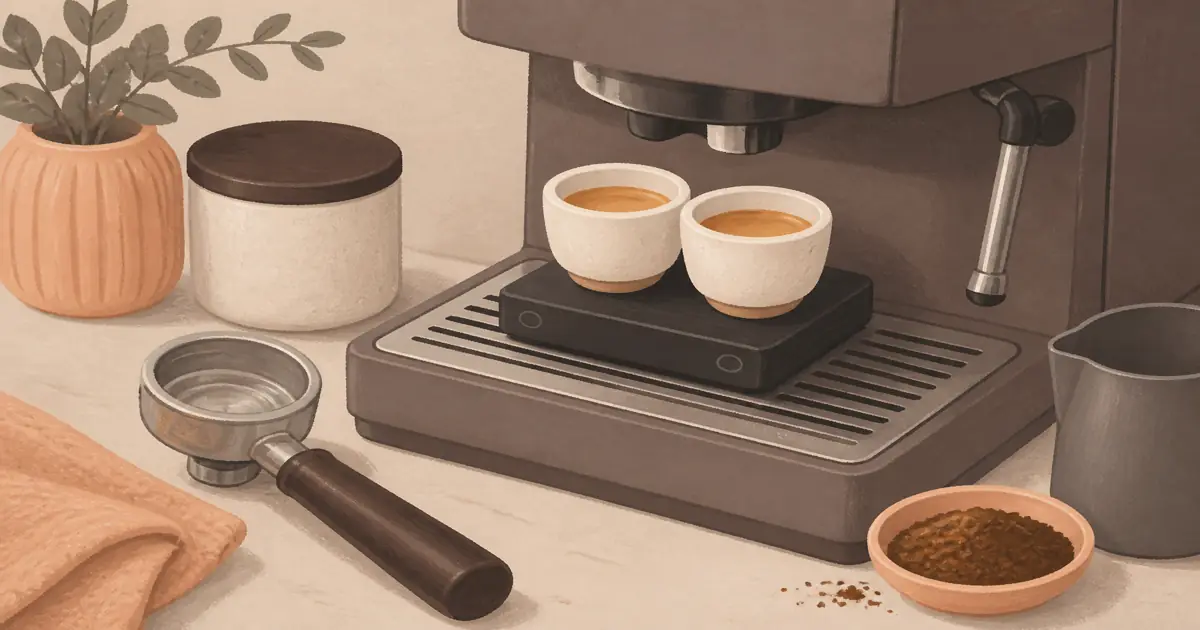
The short answer: The best espresso scale is accurate to 0.1g, has a timer you will actually start, and fits on the drip tray. Use the TIMEMORE Basic 2.0 when you want espresso-style timing on a thin scale. Use Greater Goods when you want a simpler timer scale with a splash cover.
Our picks
Espresso without a scale is vibes. You guess the dose, guess the yield, and then guess why Tuesday tasted better than Thursday. A scale turns that into numbers you can repeat. You still need a grinder that can move in small steps. The scale just tells you what you did.
These picks are research-based from live US listings and review patterns. We did not lab-certify every load cell.
TIMEMORE when you want espresso features
The TIMEMORE Coffee Scale Basic 2.0 is the espresso-leaning pick. It is thin, USB-rechargeable, and built around timer and flow-rate behavior rather than a generic kitchen display. That matters when you tare a cup, start a shot, and want yield and time in one glance.
The body is the other reason to consider it. Many drip trays are shallow. A chunky kitchen scale shoves the cups into the portafilter. A low slab survives more machines.
It is not a toy for weighing one bean at a time. The useful range starts around half a gram. Dose 18g in, 36g out, watch the time. That is the job.
Greater Goods when you want simple and sturdy
The Greater Goods coffee scale with timer is the practical alternative. 0.1g, a count-up and count-down timer, and a silicone cover you can rinse. The display is obvious. The price is usually kinder. The review record is large.
It is a bit more “coffee scale” than “espresso slab.” If your drip tray is tight, measure before you buy. If you brew pour over on the same scale, the larger platform is a plus.
Choose this if you do not care about flow-rate readouts and you want something you can splash and wipe.
What to weigh, in order
- Dose into the portafilter or a dosing cup. Tare. Grind. Check you hit the number.
- Tare the cups on the scale, on the drip tray if they fit.
- Start the shot and the timer together.
- Stop at your target yield, often around 1:2 in 25 to 35 seconds as a starting band, not a religion.
If the shot runs fast and tastes sour, grind finer or dose up a touch. If it crawls and tastes harsh, grind coarser. The scale does not fix the puck. A WDT tool and a level tamp still do that work.
Fit, heat, and water
Measure your drip tray. Note the height under the spouts. A scale that does not fit becomes a counter scale, and then you stop using it for shots.
Keep water off the buttons. Steam and splashes happen. The Greater Goods cover helps. The TIMEMORE wants a bit more care around the ports. Neither scale wants a trip through the dishwasher.
Place the scale after you lock in the portafilter if space is tight. Do not knock the scale with the handle every shot. That is how load cells get weird.
A simple number set for the first week
Pick one basket and stay there. Many home doubles sit around 16 to 18 grams in. Start near 1:2 out, so 18 in and 36 out. Time the shot. If you land in the mid-20s to mid-30s of seconds and the cup is not awful, you have a baseline.
Change one thing at a time. Grind first. Dose second. Yield third. If you change all three, the scale cannot tell you which lever worked.
Weigh beans into the grinder hopper only if you single-dose. Hopper grinding is fine, but then weigh the portafilter after you grind, not the bag.
Replace batteries or recharge before the display fades mid-shot. Auto-off is useful on the counter and rude during a 35-second extraction. If your scale dies at 20 seconds, turn auto-off off or pick a model that keeps the timer alive.
Write the numbers on a sticky note for one bag of beans. When the bag changes, expect the numbers to move. That is normal, not a broken scale.
When a cheap kitchen scale is a waste
A 1g kitchen scale cannot dose espresso. An 0.1g scale that auto-off after 60 seconds will die mid-shot. A scale that takes two seconds to settle is annoying when you are pouring milk and watching blonding.
Spend the coffee-scale money once. You will use it for beans, pour-over, and leftover pasta if you are honest.
Bottom line
The best espresso scale is the one you can leave on the tray and trust. TIMEMORE Basic 2.0 for a thin, timer-forward espresso workflow. Greater Goods for a tougher, simpler 0.1g timer at a friendlier price. Weigh dose and yield for a week and your beginner machine will suddenly taste less random.
More setup guides sit on the blog. The homepage has grinders and machines if the scale just revealed you need both.
Frequently Asked Questions
What is the best espresso scale for most home bars?
If you want shot timing and a thin tray fit, the TIMEMORE Basic 2.0. If you want a straightforward 0.1g timer scale with a splash cover, Greater Goods.
Do I need 0.01g?
No. Espresso dosing at home is a 0.1g job. Finer resolution is for people chasing single beans, not weekday doubles.
Can I use a kitchen scale?
If it reads 0.1g and does not auto-off in 30 seconds, maybe. Most kitchen scales are too tall, too slow, or they shut off mid-shot.
Why does my scale jump near the grinder?
Motors throw the reading. Tare on the drip tray, not next to a spinning burr set.
Timer on the scale or on my phone?
On the scale. Phones get wet and you will forget to start them. A scale timer sits where the cups sit.